Sell a gold guinea
The English and later British gold coin from 1663 to 1814, in 22-carat gold. A piece of history that we assess on its gold and on its collector value.
- Purity
- 916.7‰ (22 carat)
- Country
- United Kingdom
- Gold rate
- €112.63/g
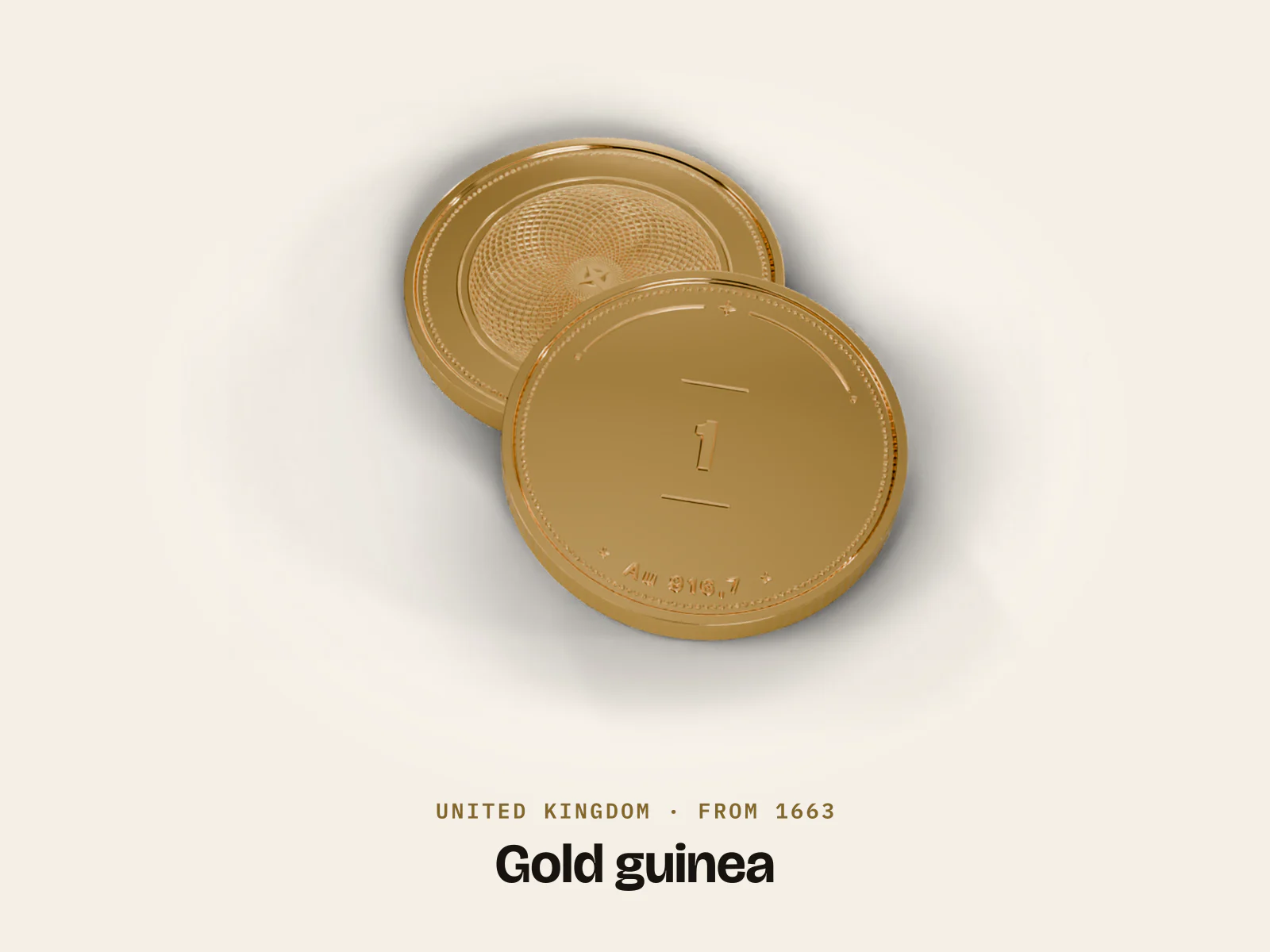
What do we pay for a gold guinea?
Based on the gold rate of this moment, €112.63 per gram of fine material. We keep no margin on this coin: you receive the full gold rate. As of:
| Variant | Fine gold | Total weight | We pay |
|---|---|---|---|
| 1 guinea | 7.688 g | 8.39 g | €865.89 |
| 1/2 guinea | 3.845 g | 4.19 g | €433.00 |
This price applies regardless of the year and the mint. With a rare year or exceptional condition the collector’s value can be higher than the material value – then we say so, even if that means you are better off not selling us the coin.
How we arrive at this amount
A coin is precious metal in a recognisable shape. What it fetches therefore depends almost entirely on the fine weight: the weight of pure gold it contains.
This coin is 916.7‰ (22 carat) pure. The rest of the alloy – usually copper – makes it harder and scratch-resistant, but has no value. That is why we calculate on the fine weight and not on what the scales say.
The predecessor of the Sovereign: struck from 1663 to 1814, after which the Sovereign of 1817 took over.
Not sure whether your coin is genuine? We check weight, diameter and thickness and measure the fineness with X-ray analysis – the handheld device comes to every appointment, including at your home. Non-destructive: your coin stays intact.
Also have a look at today’s gold rate or all gold prices.
The coin that became a pound and a shilling
The guinea was struck from 1663 and its value in silver money fluctuated for a long time. In the end it was fixed at 21 shillings. In 1817 came the Sovereign of 20 shillings, and with it the guinea disappeared as a coin – although the word lived on in prices for generations.


Gold or collector’s piece
A guinea contains about 7.69 grams of fine gold. But most guineas are two to three centuries old, and with this coin date, monarch and condition often count for more than the gold. We therefore always value both and tell you which is higher.
A hole, a loop or traces of a mount are common on guineas that were worn as jewellery. The gold value then remains.
How to sell your gold guinea
From arrival to being paid usually takes less than half an hour.
Do not polish it
With collector coins, cleaning can push the value down considerably. A natural patina belongs to them.
Bring it in
By appointment at one of our 45 locations, or without an appointment at our head office in Eindhoven. If the coin is in a holder, leave it in there.
We assess two values
The precious metal and what the coin itself does: year, mintage and condition. You get the higher of the two.
Paid out straight away
In cash up to € 3,000 in the Netherlands and up to € 500 in Belgium; larger amounts reach your account within 24 hours.
Also of interest
Questions about selling gold guinea
How much gold is in a guinea?
About 7.69 grams of fine gold, in a coin of around 8.39 grams of 22-carat gold, a fineness of 916.7. The half guinea weighs about 4.19 grams and contains half that: around 3.84 grams of fine gold. Because most guineas are two to three centuries old and often circulated for a long time, wear can make the actual weight slightly lower. That is why we weigh every coin ourselves on a calibrated scale and measure the fineness with the X-ray device, without damaging it. We settle the fine gold at the spot price with no margin. With a guinea, though, the gold is often only the floor: date, monarch and condition can be worth more.
Is my guinea worth more than its gold?
Often, yes. Most guineas are two to three centuries old, and with this coin monarch, date and condition often count for more than the gold. We therefore always value both: the gold value of about 7.69 grams of fine gold per guinea, at the spot price with no margin, and the collector value. We tell you honestly which value is higher. A hole, a loop or traces of a mount are common on guineas that were worn as jewellery; the gold value then remains. Do not clean the coin beforehand, because polishing can lower the collector value considerably. The valuation is free and without obligation, even if you decide afterwards to keep the guinea.
What is the difference from a Sovereign?
The guinea is older and heavier. It was struck from 1663 to 1814 and was eventually fixed at 21 shillings; the Sovereign of 1817 was worth 20 shillings and took its place. A guinea of around 8.39 grams of 22-carat gold contains about 7.69 grams of fine gold, a Sovereign 7.32 grams. The word guinea lived on in prices for generations. We settle both coins on the fine gold at the spot price with no margin, but with the guinea, given its age, we always look at the collector value as well: date, monarch and condition. The Sovereign has its own page.
Should I clean the coin?
No, certainly not. With old coins, polishing can lower the collector value considerably, and with a guinea that collector value is often higher than the gold. Even careful polishing leaves fine scratches that an expert sees at once, and they cannot be undone. For the gold value a dark or dirty coin makes no difference: we pay the roughly 7.69 grams of fine gold at the spot price with no margin, whether the coin shines or not. So bring it as it is, preferably wrapped separately so that it does not rub against other coins. At the table we look at date, monarch and condition and tell you what the coin is worth.
Is your question not listed? Ask it below, call 085 060 3009 or go to contact.
A question about gold guinea?
Ask it here. You will receive a personal reply by email, usually within one working day – no automated message and no phone call you did not ask for.
- An answer from a valuer, not from a template
- We keep your question so that you need not repeat anything
- No sales pitch afterwards
Sources
Where you can verify what you have just read.
- Koninklijke Nederlandse MuntThe mint that struck the Dutch coins and knows their fineness
- De Nederlandsche BankOn the guilder and exchanging old legal tender
- WaarborgHollandThe Dutch assay office that verifies fineness and strikes hallmarks
Have your gold guinea valued?
Free and without obligation, at a location near you.