Selling jewellery with stones: does the stone count, or only the gold?
The short answer: it depends on the stone. We assess diamonds, rubies, sapphires and emeralds separately from the gold or platinum. For pearls and semi-precious stones such as amethyst and aquamarine we pay for the metal only. The weight of the stone never counts as gold weight.


The metal and the stone are two separate things
For us, a piece of jewellery with stones consists of two parts: the precious metal and what is set in it. We settle the gold or platinum on weight, fineness and the price of the day. We look at the stone separately.
The weight of the stone does not count as gold weight. A ring that weighs 6 grams on your scale therefore contains less than 6 grams of gold if there is a stone in it. Keep that in mind when you make an estimate at home.
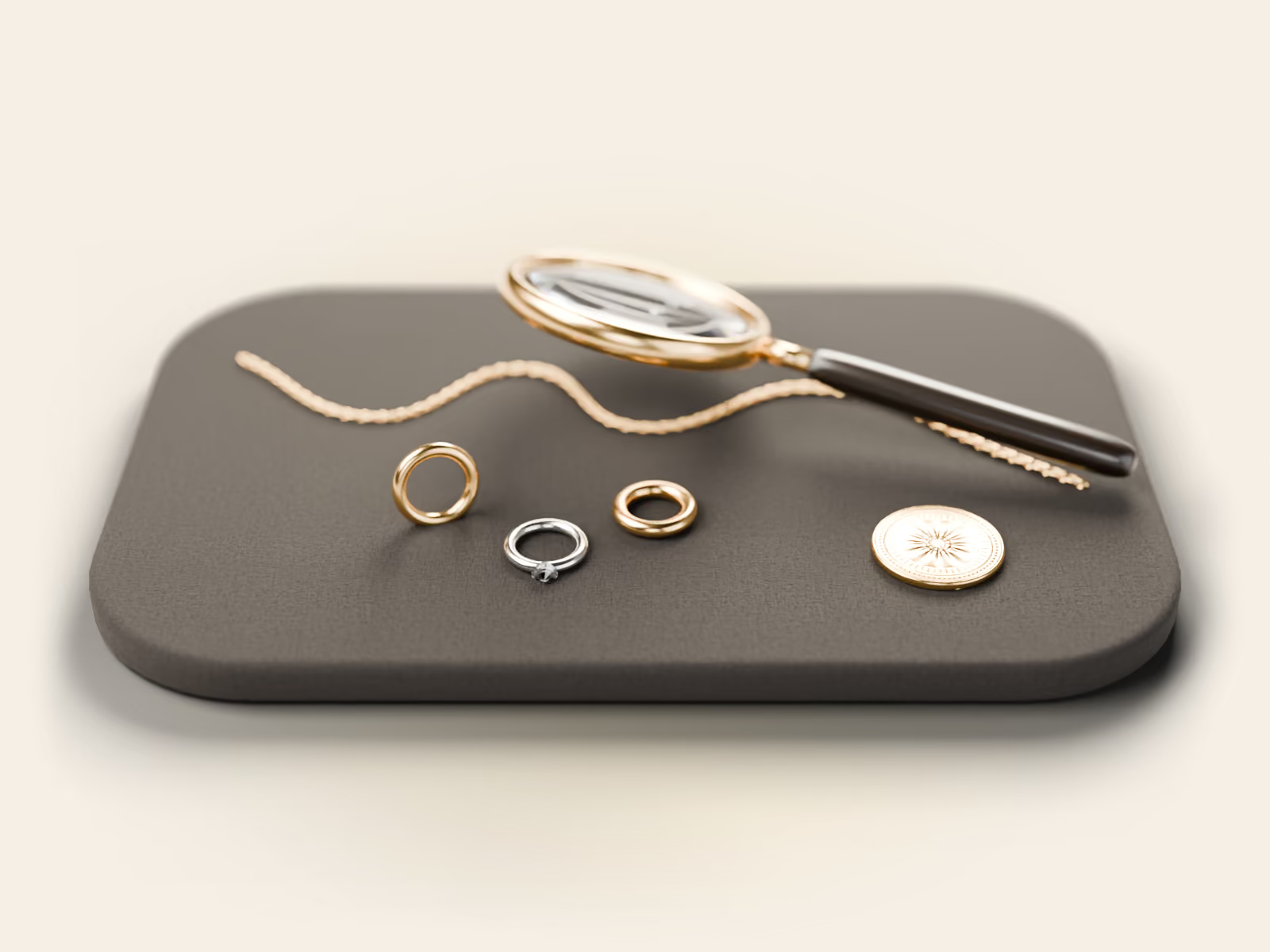
Diamond: assessed on the four Cs
Diamonds are assessed by our gemmologists on the four Cs: carat (the weight), colour, clarity and cut. We value the gold or platinum of the setting separately. So you receive an amount for the stone and an amount for the metal.
We also take small diamonds, from 0.01 ct; these are assessed together as a parcel. If you have a report from GIA, IGI or HRD, bring it along: it counts in the assessment. For large stones, the specialists are at our head office in Eindhoven.
No report with your diamond? You can still sell it. What a missing report means is explained in selling a diamond without a certificate. More about how we buy is on selling diamonds.
Ruby, sapphire and emerald
We buy rubies, sapphires and emeralds. With these stones four things determine the value: the colour, the origin, the treatment the stone has undergone and a laboratory report that records this. Two stones of the same size can therefore be far apart.
That is why an amount cannot be named in advance; it follows from the assessment of the stone itself. Here too we settle the gold of the ring or pendant separately. Read more on selling gemstones.
Pearls and semi-precious stones: the metal only
For pearls and for semi-precious stones such as amethyst, aquamarine, garnet and opal we pay for the metal only, whether the stone is genuine or not. That also applies to a vintage ring with such a stone: we value it on the gold.
Why these stones bring in so little when sold is explained in pearls and semi-precious stones.
Is there a stone in it that is really worth something? Then we tell you, and we advise you not to sell it along with the gold.
What we do not buy, and how the valuation works
We do not buy rolled gold (doublé), plaqué or gold-filled pieces, with or without a stone. The hallmark often already shows what you are dealing with; how to read it is explained in recognising hallmarks in jewellery.
The valuation is free and without obligation. We state the amount, and after that you decide for yourself whether to sell.
- Do I get the amount the calculator shows? On melting costs and other deductionsThe amount in the calculator is the amount we pay out, at the weight and fineness we measure at the table. The margin is already included and no melting or valuation costs are added.Read on
- Selling a gold watch: gold value or watch value?With a gold watch from a lesser-known brand the gold is often the price; with a sought-after brand it is the watch. How to tell which applies to yours, and how much of the weight is actually gold.Read on
- Real or fake Rolex? Serial number, year of manufacture and the tell-tale signsWhere to find the serial and reference numbers, what they tell you about the year and the version, and which signs you can check yourself. Plus why certainty only comes once the case is open.Read on
Questions about selling jewellery with stones: does the stone count, or only the gold
Is jewellery with stones valued higher?
That depends on the stone. If it contains diamond, our gemmologists assess it on the four Cs and we value the gold or platinum separately; you then receive an amount for the stone and an amount for the metal. We also buy rubies, sapphires and emeralds; there colour, origin, treatment and a laboratory report determine the value. For pearls and semi-precious stones such as amethyst, aquamarine, garnet and opal we pay for the metal only. In every case the weight of the stone does not count as gold weight.
Do you value a vintage ring with amethyst or aquamarine on the gold value only?
Yes. Amethyst and aquamarine are semi-precious stones, and for those we pay for the metal only, whether the stone is genuine or not. The ring is weighed on a calibrated scale and the fineness is measured; the weight of the stone does not count as gold weight. If there is a stone in it that is really worth something, we tell you and advise you not to sell it along with the gold. The valuation is free and without obligation, and you only decide after you have heard the amount.
Do you value a piece as a whole, or the stone and the gold separately?
Separately. We settle the gold or platinum on weight, fineness and the price of the day, and the weight of the stone does not count in that. Diamonds are assessed by gemmologists on the four Cs; we take small diamonds from 0.01 ct, and reports from GIA, IGI and HRD count. Rubies, sapphires and emeralds are assessed on colour, origin, treatment and a laboratory report if there is one. For pearls and semi-precious stones we pay for the metal only. We do not buy rolled gold (doublé), plaqué or gold-filled pieces.
Is your question not listed? Ask it below, call 085 060 3009 or go to contact.
Still something unclear?
Ask it here. You will receive a personal reply by email, usually within one working day – no automated message and no phone call you did not ask for.
- An answer from a valuer, not from a template
- We keep your question so that you need not repeat anything
- No sales pitch afterwards
Sources
Where you can verify what you have just read.
- LBMAThe London gold and silver price our daily rate is built on
- WaarborgHollandThe Dutch assay office that verifies fineness and strikes hallmarks
Rather just have it looked at?
A valuation is free and without obligation, at a location near you.